
The techno-economic model (TEM) underpins early commercial decision making around direct air capture (DAC) projects, providing an essential indicator of how much a plant will cost. Yet, as proprietary non-standard tools that essentially rest on self-reporting, direct air capture TEMs can produce a wide range of outputs that are determined by the assumption sets used. This means evaluating the cost of one DAC technology against another is never a simple apples to apples comparison.
We’ve seen first-hand during RFP bids how this can play out to the detriment of all parties involved, where DAC developers quoting unrealistically low costs have won out only to disappoint down the line — delaying projects and eroding buyer confidence in the process.
In the absence of an industrial standard, how can project developers looking to procure direct air capture technology protect against expensive surprises? How can they benchmark quotes? What do they need to take into account? And what can they discount?
To help to answer these questions, we’ve broken down the key points around accuracy, assumptions, and detail that we believe every buyer needs to understand and scrutinise, offering insights from our own TEM-informed quotations to provide a benchmark.
The role of direct air capture techno-economic models in early quotes
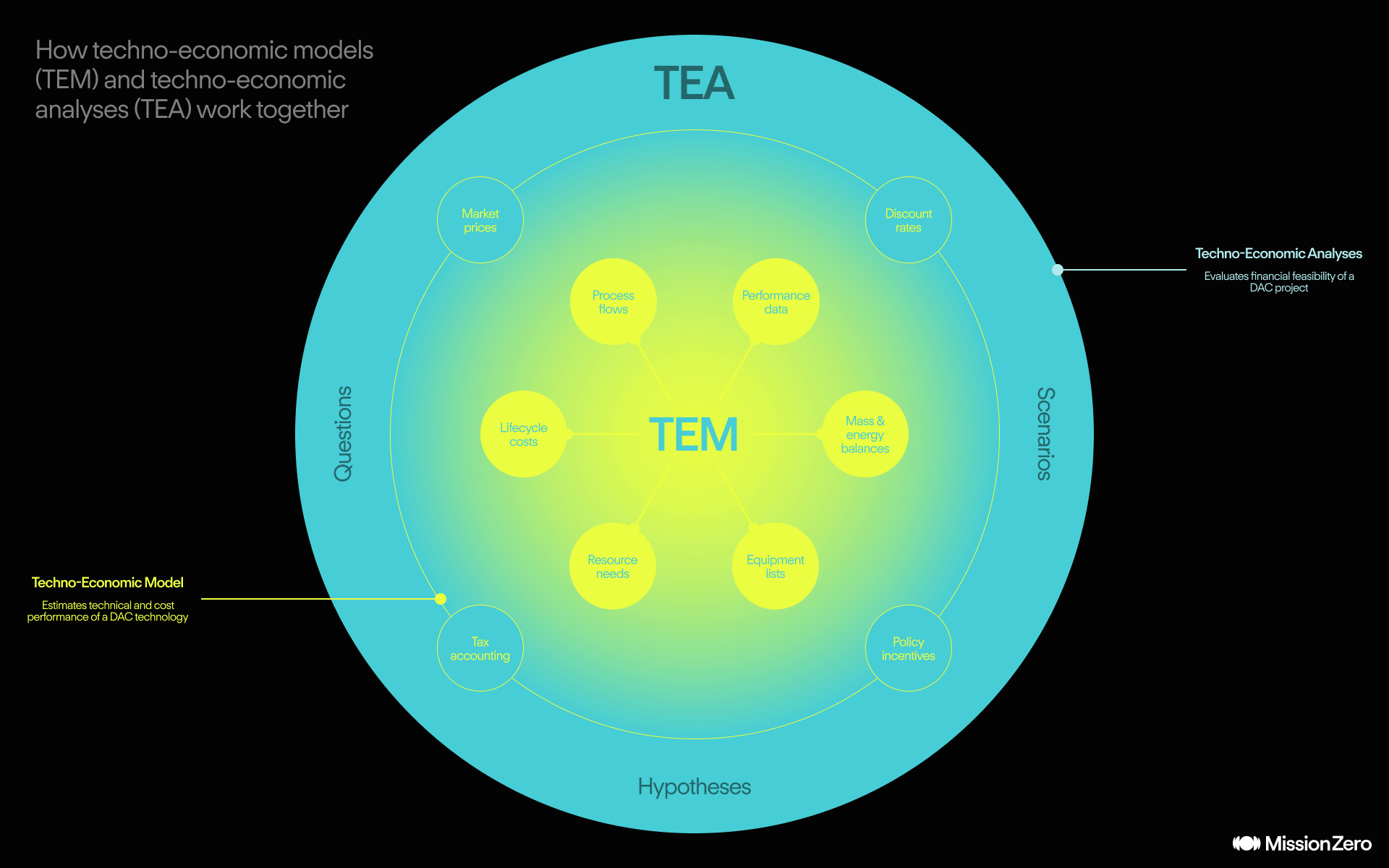
Techno-economic models (TEM) are crucial tools for developing industrial technologies. They dynamically map technical inputs within a process with capital and operating expenditures (CapEx and OpEx) across a given plant lifetime to land at an underlying cost basis. Within DAC, this helps to answer the all-important question: what is the levelised cost of capturing one tonne of CO₂?
In the broader context of techno-economic analysis (TEA), a good TEM acts as the spine of a DAC company, enabling technical, commercial, and strategic alignment for quality decision-making and prioritisation. Externally, TEMs are also pivotal for early partner conversations, helping to generate initial forecasts of costs and profitability.
Given that TEA has such a significant impact on shaping commercial opportunities, there’s a huge responsibility for the underlying models to be as representative and accurate as possible. That's particularly challenging for DAC because very few technology developers have long-term operational data in realistic conditions, and often suffer from poorly developed supply chains.
DAC customers face another challenge: fair comparison. They are comparing TEA outputs from radically different direct air capture technologies, each at a different stage of technical, engineering design, and operational maturity, and there is no standardised model to compare them against. Every developer's TEM is different; the output depends entirely on what the developer puts in. That reflects the choices they have made and what they actually know about their technology. It covers not just the underlying process, but everything involved in delivering, constructing, operating and maintaining a DAC facility over its stated lifetime.
What buyers need to interrogate when receiving a DAC quote
All of the above massively impacts the actual quotes a DAC buyer receives. While early cost estimates naturally come with a certain margin of error, they should still be robust enough to not completely mislead a project developer as to the financial viability of a project.
We’ve already broken down the key cost drivers impacting direct air capture price in a previous article, but wanted to shine a light on important nuances that can significantly influence early estimates, offering transparency around our own direct air capture techno-economic model in the process, so buyers are better armed to navigate a diverse range of DAC vendor quotes. Here’s what every DAC buyer should scrutinise across their quotes.
What’s the maturity of the data underlying the TEM?
TEM data can be derived from a diversity of sources, spanning in-house test stands, in-field demonstrators, supply chain quotations for components and equipment, front-end engineering design studies, and academic literature. Within these, the amount and continuity of operational data matters, as does the operational capacity and scale it’s drawn from.
Simply put, a quote from a DAC developer that has never deployed their technology outside of the lab, generated significant operational hours on a relevant scale to validate process stability, or evidenced supply chain relationships for the plant scale you are looking for cannot enjoy the same level of accuracy as a quote from a developer that has.
Operating hours matter most for the costs that only show up over time. Within electrochemical direct air capture, for example, sorbents, solvents and membranes degrade with use, so a plant’s energy consumption and capture rate drift away from their beginning-of-life values. A developer without long continuous run time cannot know its degradation curve; instead they will tend to report KPIs for fresh material and underestimate how often that material needs replacing. Weather works the same way: capture rate and energy use depend on air temperature and humidity, so performance validated at one site in one season does not transfer to every location.
What buyers should interrogate around direct air capture TEM data maturity
- What is the basis for core process validation: lab or in-the-field deployments?
- How many operational hours (total and continuous) has the DAC process operated and under what conditions?
- Was the technology validated at a scale relevant to the capacity required?
- How much of the CapEx quotation is based on firm supply chain vendor data?
- Are energy and capture rate figures lifetime averages or beginning-of-life values?
- What degradation rate and replacement interval are assumed, and what operating data supports them?
- Is performance quoted at design-point conditions, or as an annual average?


Direct air capture techno-economic models that draw on substantial data from in-field operational plants and supply chain vendors are more likely to deliver realistic quotes than those based purely on lab-scale demonstrators.
What assumptions has the DAC developer baked into the TEM?
When a buyer’s project details aren’t yet available, DAC developers simplify early quotations by modelling them on a set of assumptions about the deployment. A transparent quote communicates these up front, and an honest one ensures they actually reflect reality. Here are a few assumptions buyers should watch out for.
Power price assumptions
Energy is often the largest part of DAC operating cost, and assumed power prices can range from under £50/MWh to well over £110/MWh. Any quoted cost should state its power price and the share of operating cost that energy accounts for, so readers can compare quotes on the same basis;
Embodied emissions and grid carbon intensity
A cost per tonne of captured CO₂ can be much lower than a cost per tonne of net CO₂ removed. Net removal accounts for emissions from construction, materials, and consumables, and from the electricity used. Any quoted cost should say whether it is gross or net, what lifecycle emissions it includes, and the carbon intensity of the electricity it assumes (gCO₂/kWh);
Optimistic uptime rates
It’s unlikely that a brand new DAC plant running for the first time will achieve 100% capacity operations. We allow for 90% uptime, which is a combination of the standard used within the chemical plant industry and insights from our in-field deployments;
Operator staffing
Labour can be a large share of operating cost, especially at small plants. Quotes may assume anything from unmanned remote operation or shared site staff to dedicated 24/7 shift crews. Any quoted cost should state the staffing level and shift pattern it assumes, and the labour cost basis;
Low materials or equipment replacement rates
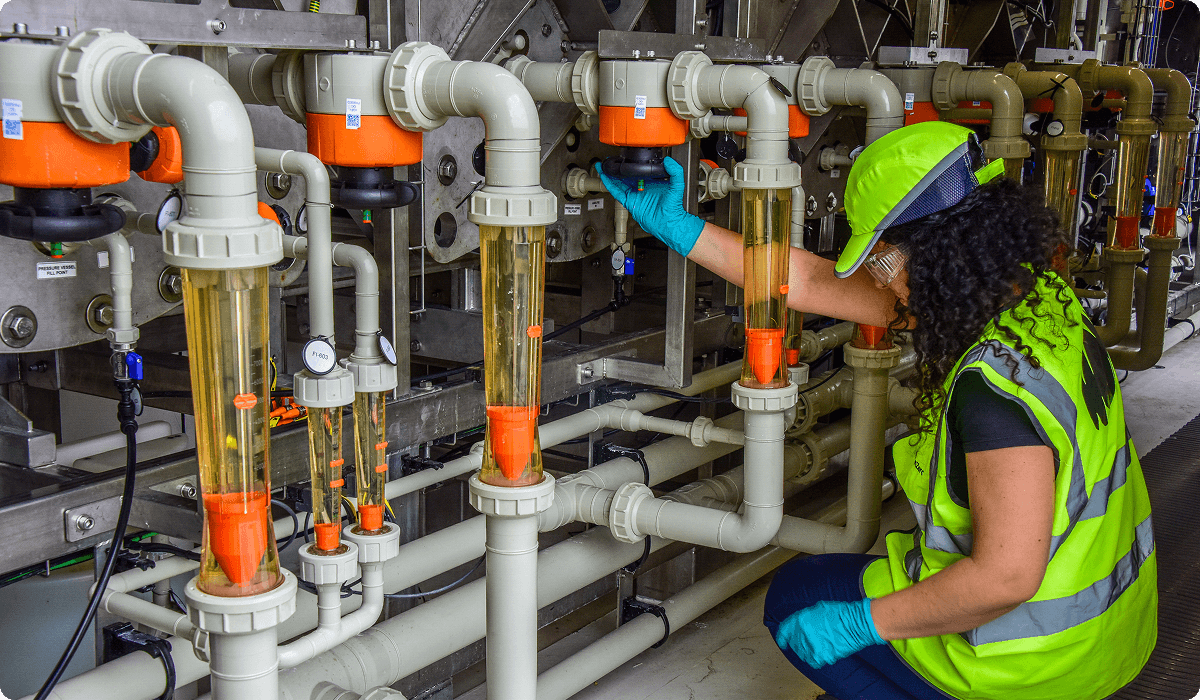
If the DAC developer has never run their process outside of the lab or at a comparable scale to the volume needed, they won’t have sufficient experience to inform component degradation;
Long levelisation periods
A DAC plant may physically operate for 25 to 30 years, but that is not the right period over which to recover its cost. Investors expect a return well before then, and levelising over 30 rather than 15 years cuts the annual capital charge by roughly 20 to 25% at typical discount rates. Buyers should ask what period a quote is levelised over and check that equipment replacements within it are costed. At Mission Zero, we levelise over 15 years, in line with the investment horizon our project partners expect;
Low contingency thresholds
Realistic quotes should add a cost buffer to cover engineering elements that the DAC developer may have overlooked, as well as market volatility. The level of contingency depends strongly on the engineering maturity and AACE class of estimate behind a certain process. We bake contingencies into our headline cost-per-tonne numbers, informed by the Class 3 estimates we have already produced around our technology. As a rule, modular DAC technologies like ours are much less likely to incur the contingency costs of non-modular ones;
Appropriate scaling factors
Scaling exponents are used to produce cost estimates and are highly dependent on the specific type of equipment that’s been scaled: Electrical, Control and Instrumentation can scale highly aggressively, as low as 0.2-0.4; common plant equipment such as pumps, compressors, and heat exchanges are in the range of 0.5-0.8; while more modular equipment such as membranes and stacks are 0.9-1 (excluding volume discounts).
Not accounting for by-product handling
Some DAC processes produce by-products such as water, hydrogen, or waste heat. While many DAC developers market these as benefits, the cost of processing and handling them needs to be honestly reported.
Level of detail included in the direct air capture TEM
While a TEM should theoretically capture every possible capital and operational expenditure, in reality this is rarely the case without understanding the fine details of a customer's site. This is down to both a DAC developer’s experience — actually knowing the full extent of both CapEx and OpEx inputs — and, to a degree, the choices they make around what to include for an early-stage conversation.
At Mission Zero, we lead with a practical, transparent approach to cost, providing potential buyers with the exhaustive list of factors that will determine the final cost-per-tonne figure. Having deployed our technology three times, we intimately know how our plants actually come together, meaning we can, for example, specify exactly how much steel or concrete is needed to lay the foundations under an air contactor.
Overlooked costs we include in proposals which other DAC developers may not:
- Total consumables — The cost of every single consumable required to operate the plant, including waste disposal;
- Labour — This includes contracted labour during deployment and operational overhead;
- Cost of goods installed — This includes the cost of construction, rather than just simply the cost of equipment;
- Equipment to enable MRV — We include the cost of the kit required to meet the most rigorous standards currently available. It’s worth noting that differing Measurement, Reporting, and Verification standards can affect estimate comparison;
- Equipment supporting core operations — We include minimum safety equipment required to operate the system, such as safety showers, as well as chemical mixing equipment in instances where this is not already available on a site.
Key takeaways for direct air capture buyers
- A DAC vendor quote is only as accurate as the data it’s based on. Optimistic quotes based on limited lab data or external estimates should be treated differently to pricier ones based on extensive in-field operational hours and deployment experience.
- Every TEM has baked-in assumptions. These should be shared up front and be grounded in the practical reality of what it means to operate a brand new plant.
- Some TEMs are more detailed than others. This comes down to the maturity of the underlying process design, the DAC developer’s experience deploying, and conscious choices DAC vendors make around where to draw input boundaries.
- DAC developer experience matters. It can be hard for a DAC vendor to include indirect operating costs or account for things like how long elements of their plant will last when they have little real-world deployment and operational experience to draw on.
- Net negativity is king. Not gross. Net negativity clarifies the CO₂ produced by the process, for example through embodied emissions, consumables, and energy source carbon intensity. Ask your DAC vendors about cost in terms of tonnes delivered and tonnes removed.